Top 15 Upcoming Infrastructure Projects in India 2026–2030
Major opportunities for construction companies, EPC contractors, equipment manufacturers and building-material suppliers across highways, rail, metro, logistics and urban infrastructure.
Overview
India’s infrastructure sector is entering an important phase
India’s infrastructure sector is entering an important phase of development, with investments in highways, expressways, high-speed rail, metro networks, logistics hubs, airports and industrial corridors. These projects are expected to create opportunities for construction companies, EPC contractors, infrastructure developers, equipment manufacturers and building-material suppliers over the coming years.
From large road corridors to modern railway networks, infrastructure development is changing how people travel, how goods move and how businesses connect with new markets. Government initiatives such as PM GatiShakti, National Infrastructure Pipeline-related planning and multimodal logistics development are also influencing project planning and execution.
According to the Ministry of Road Transport and Highways, 10,389 km of National High-Speed Corridors had been awarded by July 2026, including 4,809 km completed and 5,580 km under implementation. This demonstrates the scale of development taking place in India's road infrastructure sector. [Source: Press Information Bureau]
In this article, we explore 15 major infrastructure projects and development programmes to watch between 2026 and 2030, their significance, the construction technologies they may require and the business opportunities they can create.
Why It Matters
Why Is India’s Infrastructure Sector Important in 2026?
Infrastructure supports economic activity by improving connectivity, strengthening supply chains, supporting industrial development and creating access to new markets. Roads, railways, airports, ports, metro systems and logistics facilities all play an important role in this process.
For the construction industry, infrastructure development creates demand for machinery, engineering services, construction materials, project management, safety systems and specialised technical solutions. Major areas of opportunity include:
Roads & Expressways
Earthmoving, grading, paving, compaction and bridge construction.
Railways & High-Speed
Track systems, tunnels, bridges, signalling and electrification.
Metro & Urban Transport
Underground construction, elevated viaducts, stations and mechanical systems.
Logistics & Industrial
Warehouses, freight terminals, material-handling systems and industrial buildings.
Water & Urban
Pipelines, wastewater treatment, drainage and water-management systems.
The List
Top 15 Upcoming Infrastructure Projects in India 2026–2030
Mumbai–Ahmedabad High-Speed Rail Project
The Mumbai–Ahmedabad High-Speed Rail Project is one of India's most significant railway infrastructure developments. The corridor is approximately 508 km long and is designed for high-speed passenger services.
The project involves complex engineering, including elevated viaducts, bridges, tunnels, stations, track systems, electrical infrastructure and advanced railway technology.
Construction opportunities
- Concrete, cement & specialised materials
- Tunnel & bridge construction equipment
- Track-laying & railway maintenance machinery
- Electrical, signalling & safety systems
- Engineering, testing & quality control
The Ministry of Statistics and Programme Implementation's infrastructure monitoring portal lists the project with a revised completion date of December 2029. Project timelines can change, so businesses should check the latest official progress updates before making investment decisions.
Source: MoSPI project monitoring portal →Seven New High-Speed Rail Corridors
The Union Budget 2026–27 announced seven new high-speed rail corridors, expanding India's plans for faster intercity connectivity. The corridors announced include:
- Mumbai–Pune
- Pune–Hyderabad
- Hyderabad–Bengaluru
- Hyderabad–Chennai
- Chennai–Bengaluru
- Delhi–Varanasi
- Varanasi–Siliguri
These are planned corridors, and their implementation depends on detailed project reports, technical and economic feasibility, approvals, funding and other project-specific requirements. They should not all be treated as active construction sites.
Potential industry opportunities
Rail infrastructure planning can create demand for feasibility studies, surveying, geotechnical investigation, design services, construction materials and specialised railway systems as individual projects progress through approval and procurement stages. Businesses should monitor announcements from the Ministry of Railways and the relevant project agencies for confirmed tenders.
Source: Press Information Bureau →Dankuni–Surat Dedicated Freight Corridor
A new 2,052 km Dedicated Freight Corridor between Dankuni in West Bengal and Surat in Gujarat was announced in the Union Budget 2026–27. The proposed east–west freight corridor aims to strengthen freight connectivity and improve the movement of goods between important industrial and commercial regions.
Dedicated freight infrastructure can support more efficient cargo movement and improve links between manufacturing centres, ports, warehouses and distribution networks.
Potential opportunities
- Railway track & civil engineering
- Bridges & railway structures
- Signalling & telecommunications
- Freight terminals & loading facilities
- Construction equipment & railway maintenance systems
The announced corridor should be distinguished from the Eastern and Western Dedicated Freight Corridors, which have already been commissioned.
Source: Press Information Bureau →National High-Speed Corridors & Greenfield Expressways
India's national high-speed corridors and greenfield expressways are designed to improve road connectivity, reduce travel times and strengthen links between major economic centres. The Ministry of Road Transport and Highways reported that 10,389 km of National High-Speed Corridors had been awarded by July 2026, of which 5,580 km remained under implementation at that time.
These projects involve extensive civil engineering work, including road formation, embankments, bridges, interchanges, drainage systems and pavement construction.
Key equipment & materials
- Excavators, bulldozers & motor graders
- Asphalt plants & pavers
- Road rollers & soil compactors
- Crushers & screening equipment
- Ready-mix concrete plants
- Geosynthetics, bitumen & construction chemicals
Equipment suppliers and construction-material manufacturers can track project packages and tender notices to identify opportunities with contractors and EPC companies.
Source: Ministry of Road Transport and Highways via PIB →Bharatmala Pariyojana & Economic Corridors
Bharatmala Pariyojana is a major highway development programme focused on economic corridors, inter-corridor routes, feeder roads, border connectivity, coastal roads and expressways. The programme is intended to improve the efficiency of road transport and connect industrial centres, ports and important commercial destinations.
According to a Ministry of Road Transport and Highways backgrounder published in June 2026, 26,425 km of projects had been awarded under Bharatmala by March 2026, of which 22,590 km had been constructed. For the construction industry, the programme represents a broad range of road-development work rather than one single project scheduled for completion in 2030.
Business opportunities
Road construction machinery, pavement materials, precast products, traffic-management systems, bridge components and maintenance services. Companies should assess individual packages and current tender status rather than assume every corridor is awaiting construction.
Source: Press Information Bureau →Chennai Metro Rail Phase II
Chennai Metro Rail Phase II is a major urban transport development intended to expand metro connectivity across Chennai. The project includes extensive civil engineering, station construction, elevated and underground sections, track installation, electrical systems and passenger facilities.
Metro development requires coordination between civil contractors, system suppliers, utility providers and specialist engineering companies.
Potential opportunities
- Tunnel boring & underground construction
- Concrete, reinforcement steel & precast
- Escalators, lifts & station equipment
- Electrical & signalling systems
- Fire protection & ventilation
- Construction safety & monitoring technology
The MoSPI infrastructure monitoring portal lists Chennai Metro Rail Phase II as a major monitored project. Businesses should check the latest official project reports for its current progress and procurement requirements.
Source: MoSPI project monitoring portal →Delhi–Panipat–Karnal Namo Bharat Corridor
The proposed Delhi–Panipat–Karnal Namo Bharat corridor is intended to improve regional connectivity between Delhi and important locations in Haryana. Regional rapid transit infrastructure can support faster commuting, improve access to employment centres and strengthen the relationship between major cities and surrounding economic areas.
The corridor has been reported as a proposed network requiring the relevant approvals and implementation steps. It should not be described as fully under construction without confirmation from the responsible agency.
Potential construction opportunities
- Elevated viaducts & station structures
- Foundations & piling systems
- Railway electrification & signalling
- Passenger information systems
- Concrete & structural materials
- Surveying & geotechnical services
Companies interested in the project should monitor official announcements, approvals and procurement notices.
Gurugram Metro Rail Expansion
Gurugram continues to be an important location for urban transport and infrastructure development. The Millennium City Centre–Cyber City metro corridor is intended to strengthen connectivity within the city. The 28.5 km corridor has been reported as an approved project with an estimated cost of ₹5,452 crore. The development includes metro stations and supporting infrastructure.
Metro connectivity can influence commercial development, office locations, residential expansion and access to business districts.
Potential opportunities for suppliers
- Civil construction & structural engineering
- Electrical & mechanical systems
- Station interiors & building materials
- Lifts, escalators & ventilation
- Signalling, communications & passenger systems
- Safety equipment & construction services
Companies should check the latest updates from Gurugram Metro Rail Limited for tender packages and construction schedules.
Integrated Multimodal Logistics Hub at Nangal Chaudhary
The Integrated Multimodal Logistics Hub at Nangal Chaudhary in Haryana is an important logistics infrastructure development intended to support cargo movement and supply-chain efficiency. Such hubs can connect road and rail networks with warehousing, freight handling and distribution facilities.
The MoSPI monitoring portal lists the project's Phase I trunk infrastructure with a revised completion date of May 2028.
Potential business opportunities
- Warehouse & industrial building construction
- Material-handling equipment
- Loading & unloading systems
- Storage racks & warehouse automation
- Freight-terminal infrastructure
- Fire safety, electrical & utility systems
Logistics infrastructure can create demand not only during construction but also when the facility becomes operational and businesses establish warehousing and distribution activities.
Source: MoSPI project monitoring portal →Modernisation & Expansion of Indian Railways
Indian Railways continues to invest in track capacity, safety, passenger facilities, freight infrastructure and railway modernisation. According to the Ministry of Railways, as of 1 April 2026, 514 sanctioned railway infrastructure projects covering approximately 40,000 km were listed across new lines, gauge conversion and track doubling. These projects had an aggregate estimated cost of approximately ₹8.31 lakh crore.
The portfolio includes projects at different stages of implementation, so the total should not be interpreted as expenditure available for new tenders in 2026 alone.
Construction & manufacturing opportunities
- Sleepers, rails & track components
- Bridges, tunnels & earthworks
- Electrification equipment
- Signalling & safety technology
- Track maintenance machinery
- Construction materials & testing services
Suppliers should identify the specific railway zone, implementing agency and tender package relevant to their products.
Source: Ministry of Railways via PIB →Railway Freight Terminals & Multimodal Cargo Facilities
Freight terminals play an important role in connecting rail transport with road logistics, industrial facilities and distribution networks. The Indian Railways' Gati Shakti Multi-Modal Cargo Terminal policy encourages the development of modern freight-handling facilities and improvements to railway-owned goods sheds.
Such facilities can improve cargo loading, unloading, storage and first- and last-mile connectivity.
Potential opportunities
- Cargo-handling machinery & cranes
- Conveyors & material-handling systems
- Warehouses & storage infrastructure
- Railway sidings & terminal construction
- Weighbridges & industrial automation
- Logistics software & tracking systems
For equipment manufacturers and infrastructure suppliers, monitoring terminal-development proposals and railway tender portals can help identify relevant procurement opportunities.
PM GatiShakti & Multimodal Infrastructure Planning
PM GatiShakti is a national master-planning initiative designed to improve coordination across infrastructure projects and transport networks. It brings together information about roads, railways, ports, logistics facilities and other infrastructure layers to support integrated planning.
In March 2026, the Press Information Bureau reported that the Network Planning Group had evaluated railway, metro, road and highway projects for multimodal connectivity and logistics efficiency. PM GatiShakti is a planning framework rather than a single construction project. Its importance lies in helping identify connectivity gaps and coordinate infrastructure development.
Why it matters to construction businesses
- Visibility into regional infrastructure planning
- Opportunities around transport & industrial nodes
- Understanding of road, rail & logistics links
- Demand for surveying, GIS & engineering services
- Supply to approved projects
Companies should use the framework as a source of planning context, while relying on individual project agencies for procurement decisions.
Source: Press Information Bureau →Airport Infrastructure & Terminal Development
Airport infrastructure remains an important area of investment as cities and regional centres require better passenger and cargo connectivity. Airport projects may involve terminal buildings, runways, taxiways, apron areas, cargo facilities, access roads, parking structures and supporting utility infrastructure.
The exact scope and implementation status vary by airport. Businesses should distinguish between an approved airport project, an announced expansion and an active construction package.
Potential opportunities
- Concrete & pavement construction
- Earthmoving & grading equipment
- Steel structures & building materials
- Baggage-handling systems
- Electrical, lighting & safety systems
- HVAC, fire protection & facility management
Companies can monitor the Airports Authority of India and relevant airport operators for confirmed development plans and tender notices.
Water Supply, Wastewater & Urban Infrastructure Projects
India's urban infrastructure requirements extend beyond transport. Growing cities need reliable water supply, drainage, wastewater treatment, flood-management systems and improved public utilities. Projects in this category can involve municipal agencies, state governments, public-sector bodies and private contractors.
The construction work may include pipelines, pumping stations, sewage treatment plants, reservoirs, drainage networks and utility corridors.
Potential business opportunities
- Pipes, valves & pumping equipment
- Excavation & trenching machinery
- Water-treatment technology
- Precast concrete structures
- Waterproofing & construction chemicals
- Monitoring systems & automation
Suppliers should check project-specific specifications, applicable standards, local approvals and tender eligibility before bidding.
Regional Roads, Industrial Corridors & Supporting Infrastructure
In addition to nationally prominent projects, regional infrastructure programmes can create substantial demand for construction companies. State highways, industrial corridors, bypass roads, freight connections, industrial parks and urban infrastructure projects support the development of manufacturing and distribution networks.
Their commercial importance can be significant even when they receive less national media attention than high-speed rail or major expressways.
Opportunities for construction businesses
- Road-building & earthmoving equipment
- Building & construction materials
- Industrial sheds & factory structures
- Warehousing & storage solutions
- EPC & project-management services
- Equipment rentals, maintenance & spare parts
For suppliers, regional tenders may be more accessible than large national projects, depending on the contract size, technical qualifications and financial requirements. Businesses should review state infrastructure departments, industrial development corporations and public procurement portals to identify relevant opportunities.
Equipment Demand
Which Construction Equipment Will Be in Demand?
Different infrastructure projects require different equipment, depending on the terrain, construction method, scale and project phase.
| Equipment category | Common applications |
|---|---|
| Excavators and bulldozers | Earthmoving, site preparation and excavation |
| Motor graders | Road formation and surface preparation |
| Road rollers and compactors | Soil and pavement compaction |
| Asphalt plants and pavers | Highway and road construction |
| Cranes and lifting equipment | Bridges, stations and industrial structures |
| Concrete batching plants | Concrete production for civil works |
| Tunnel boring equipment | Underground rail and metro construction |
| Crushers and screening plants | Aggregate production and material processing |
| Forklifts and warehouse equipment | Logistics and cargo-handling facilities |
| Surveying and monitoring systems | Site measurement, planning and quality control |
Demand will depend on the number of active project packages, contractors' procurement decisions and the availability of equipment through purchase, rental or leasing.
Growth Playbook
Business Opportunities for Construction Companies and Suppliers
Infrastructure development creates opportunities across the entire construction supply chain. However, companies need to identify the right buyer and procurement channel instead of relying solely on general project announcements.
Connect with EPC Contractors
Engineering, procurement and construction companies often manage large infrastructure packages. Suppliers can research contractors working in relevant project segments and understand their vendor-registration requirements.
Identify Upcoming Tender Packages
Tender notices provide more actionable information than broad announcements. They can identify the contracting authority, technical specifications, eligibility requirements, submission deadlines and procurement scope.
Build Relationships with Equipment Buyers
Contractors, rental companies, infrastructure developers and project managers may require equipment at different stages of construction. Direct industry networking can help suppliers understand these requirements.
Expand into Regional Markets
A supplier may find suitable opportunities in state-level highways, metro extensions, industrial parks or logistics facilities. Regional projects may offer a better fit depending on the supplier's capacity and location.
Demonstrate Products and Technologies
Industry exhibitions, trade events and B2B networking platforms can help manufacturers demonstrate equipment, meet prospective buyers and build business relationships.
Step by Step
How to Find Genuine Infrastructure Business Opportunities in India
Before committing funds or production capacity, companies should follow a structured process:
- Identify the project and its implementing authority.
- Confirm whether it is proposed, approved, tendered, under construction or operational.
- Locate the relevant tender or procurement notice.
- Verify technical specifications and eligibility conditions.
- Research the EPC contractor or purchasing organisation.
- Evaluate delivery schedules, payment terms and contractual risks.
- Prepare documentation, certifications and commercial quotations.
Useful official resources:
Meet the Industry
Bharat ConX Expo 2026: Connect with India's Construction and Infrastructure Industry
As infrastructure projects create new requirements for construction equipment, materials, industrial technology and logistics solutions, building relationships with industry stakeholders becomes increasingly important.
The event offers a platform for businesses in the construction and infrastructure ecosystem to connect with manufacturers, suppliers, contractors, distributors, buyers and industry professionals. Relevant sectors include:
- Construction equipment & machinery
- Building & construction materials
- Hardware, tools & equipment
- Infrastructure development & EPC
- Warehousing, storage & intralogistics
- Logistics, supply chain & material handling
- Industrial automation & smart infrastructure
For manufacturers and suppliers looking to strengthen their industry presence, participating in a relevant B2B exhibition can support product demonstrations, business networking and prospective customer development. Companies interested in exhibiting can contact the Bharat ConX Expo team to enquire about stall availability, participation options and event details.
Book your stall at Bharat ConX Expo 2026 and connect with the construction and infrastructure business community.
Book Your Stall →FAQs
Frequently Asked Questions
1. What are the major upcoming infrastructure projects in India in 2026?
Major developments include national high-speed corridors, greenfield expressways, high-speed rail planning, metro expansion, railway capacity projects, logistics hubs and urban infrastructure. Each project has its own approval, tendering and construction schedule.
2. Which infrastructure sectors offer opportunities for construction companies?
Highways, railways, metro systems, logistics facilities, airports, industrial infrastructure, water management and urban development can create opportunities for EPC contractors, equipment suppliers, material manufacturers and engineering service providers.
3. How can construction equipment manufacturers find infrastructure projects in India?
Manufacturers can monitor official tender portals, project-monitoring dashboards, government department announcements and EPC contractor procurement notices. Vendor registration and project-specific technical qualifications may be required.
4. Are all announced infrastructure projects under construction?
No. Projects can be proposed, approved, under tender, under construction or operational. Businesses should verify the latest status through the implementing agency before planning investments or approaching buyers.
5. How can suppliers connect with infrastructure buyers?
Suppliers can build relationships with EPC contractors, project developers, equipment rental companies and procurement teams. Relevant trade exhibitions and industry networking events can also help businesses develop potential B2B connections.
6. When is Bharat ConX Expo 2026 taking place?
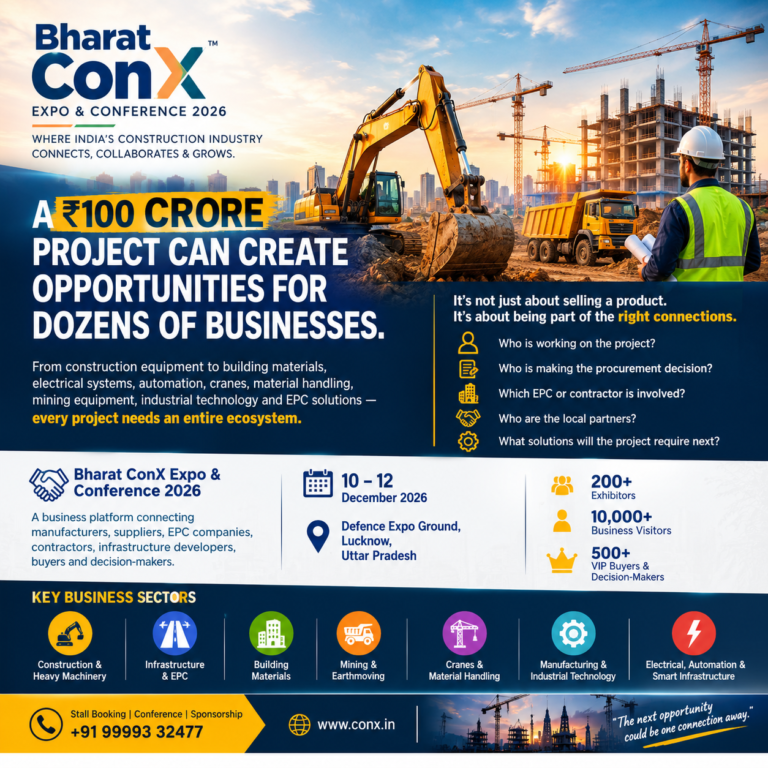
Bharat ConX Expo 2026 is scheduled for 10–12 December 2026 at Defence Expo Ground, Lucknow, Uttar Pradesh. Interested businesses can contact the organiser for exhibitor participation details.
Conclusion
Turning Infrastructure Growth into Business Growth
India's infrastructure development offers a wide range of potential opportunities for construction companies, EPC contractors, equipment manufacturers and building-material suppliers. High-speed rail, highways, metro systems, freight infrastructure and logistics facilities are among the major areas to monitor through 2030.
However, successful business development requires more than identifying a large project. Companies should verify project status, track tender announcements, understand contractor requirements and assess commercial feasibility before committing resources.
For manufacturers and suppliers, a combination of project research, targeted outreach and industry networking can help turn infrastructure developments into practical business opportunities. As India's construction and infrastructure ecosystem continues to evolve, staying informed about upcoming projects and connecting with relevant industry stakeholders will remain important for long-term business growth.
Looking to expand your presence in India's construction and infrastructure market? Explore exhibitor opportunities at Bharat ConX Expo 2026, scheduled for 10–12 December 2026 in Lucknow, Uttar Pradesh.
Explore Exhibitor Opportunities →